Europe 2031 is a bet, not a forecast
The scenario asks Europe to trade its sovereignty, climate goals and labour laws for frontier model access, on a chain of assumptions that are anything but certain.

Europe 2031 has been making the rounds, and I have some thoughts.
For those who missed it: Europe 2031 is a five-year scenario, written by a group of investors, AI researchers and security/risk-leaning think tankers, in which Europe’s failure to find a sovereign and competitive moat on AI leaves it economically devastated and politically irrelevant. By 2031 the continent is reduced to three options, all of them bad: become an American protectorate, turn to China, or fade into irrelevance.
The storytelling is compelling. It conveys a sense of urgency I happen to share: unless Europe acts decisively, it may lose its ability to shape its own future. I also share its deep sense of frustration about the way in which EU policy has responded to date: too slowly, too indecisively, and too often relying on magical thinking.
The scenario, however, is just that: one possible future among many. It relies on a whole chain of assumptions about AI, economics and geopolitics that all have to hold for it to be true. It then renders the cost of failing to act on its premises in vivid detail. But it says absolutely nothing about the very real cost of acting on them if they turn out to be false: billions spent, democratic norms suspended, Europe’s dependency on three US cloud providers deepened, all on the strength of a live hypothesis.
The reason I am writing about this at all is that its far-reaching recommendations have resonated. In the many closed-door meetings on the subject I have since attended, a new consensus seems to have formed. In a matter of weeks, the (elite) discourse has shifted from “How can Europe achieve sovereignty?” to “Europe needs proprietary frontier model access no matter the cost.”
But I am unconvinced this apparent consensus is what it seems. It has formed around a gripping piece of fiction that buries most of its assumptions and whose recommendations are, once spelled out, anything but consensual. In fact, after nearly every meeting, someone has quietly slipped me their card, saying they would like to understand this better.
In reality, there are at least two ways to get this wrong: to dismiss a dangerous scenario when it is real, and to commit to it when it is not. Europe 2031 dramatizes the first and is entirely silent on the second. Evidence-based policy making simply can’t do that. Which is why I’m going to do two things: spell out why Europe 2031’s recommendations come with real trade-offs (and may not even work), and why its entire reasoning rests on a chain of assumptions, none of them certain.
What follows is long, and nowhere near as compelling as fiction. But if you want to understand what’s at stake, bear with me.
Part I: A critique of the proposal on its own terms
I’ll get to the scenario’s many premises later. First, let’s grant all of them and assess the recommendations on their own terms.
The scenario’s radical recommendations
Strip the story back and its core theory runs something like this: AI will rival the industrial revolution, but arrive in years rather than decades. The most advanced models generate unprecedented economic value, but there is no cheap or clever shortcut to building models at the frontier. Europe’s own models are too far behind to rely on, and, while open-weight models provide a partial alternative, that option is foreclosed in any case once Washington and Beijing ban open models outright. Europe is therefore dependent across the whole stack (chips, compute, and the frontier models its economy would run on) with one point of leverage, ASML, which, in the scenario, becomes ultimately seized. That dependence is coercible: access to the frontier, and to the compute these models run on, can be revoked.
The way out, the scenario argues, is “leverage through indispensability”: a wartime-scale compute build-out (for inference, i.e. running, not training models) in partnership with American cloud providers in exchange for “security guarantees” for frontier-model access; a coalition of like-minded middle powers to pool bargaining power (not the EU itself, but a “nimble” grouping convened by the Netherlands, Germany and France alongside countries such as the UK, Canada, Japan and South Korea); a loosening of labour protections; and a pivot to robotics and industrial AI — all while bringing a deeply skeptical public along for the hard choices.
It’s worth spelling out what these proposals actually mean in practice:
The unprecedented compute build-out comes at a price
At first sight, the proposal sounds modest. It merely asks that 15 percent of global AI compute should be based in Europe by 2031. In the long-term, the authors hope that this number becomes the equivalent of Europe’s share of global GDP, closer to 25 percent. But these numbers are based on the assumption that demand for highly specialized compute needed to run large models will increase drastically over the next five years, ten fold to be precise.
As a result, a modest 15 percent AI compute share in 2031 would amount to 55 GW on European soil. Running continuously, this would draw about 480 TWh of electricity a year, or more than Germany’s entire annual electricity consumption in 2024. To put this in perspective: today, Europe’s relevant compute capacity sits at about 2 GW.
This increase from 2 GW to 55 GW would all need to be built almost from scratch, in five years, on a continent already fighting over soaring energy prices, lagging grid capacity, and missed climate targets.
This is worth stressing: we’re not even on track to power Europe’s current electricity consumption with renewables any time soon. Adding the entire annual electricity consumption of Germany certainly won’t help. Only under very strict hypothetical conditions in which massive datacenter expansion adds the same level of renewables and energy storage to Europe’s electricity grid will it not further derail Europe’s climate goals.
US hyperscalers will want real concessions
Which brings me to the next point. Building AI compute with US hyperscalers — Amazon, Microsoft, Google — sounds like Europe is simply buying the capacity it needs. But the hardware this requires is finite: global chip supply is already running near its limit, so every gigawatt built in Europe is one not built in Virginia, the Gulf, or the “middle powers” Europe is supposed to be negotiating with — all competing for the same chips, with cheaper power and typically fewer planning constraints.
The scenario’s authors recognize this reality and assume that more AI compute in Europe will mean less AI compute in the United States. However, to win that contest, Europe has to make itself the more attractive place to build. And on core factors — electricity cost, grid access, permitting — it starts behind, so it will have to sweeten the deal: tax breaks, relaxed environmental rules, guaranteed access to electricity. This is already the price hyperscalers command to build in US states competing for their datacenters.
Expect no less in Europe. The scenario itself argues for “public and private capital at a scale Europe has not attempted in peacetime,” as well as “dedicated economic zones, targeted energy policy and radically streamlined permitting.”
The projected compute demand is for running US models on US infrastructure
It’s clear that increasing Europe’s AI compute capacity so drastically will come at a price. Which raises the question of what exactly this build-out is needed for.
Interestingly, this is the question that has received least scrutiny, perhaps because the difference between AI compute and generic cloud capacity (“datacenters”) is rarely made explicit in EU policy discussions. The EU’s proposed AI and Cloud Development Act, for instance, aims to triple the continent’s data centre capacity, without specifying what kind of data center capacity this is supposed to be. But as I (and others) have argued elsewhere, these targets treat the cloud as generic capacity meeting generic demand. They conflate two very different things: the ordinary cloud capacity on which European businesses and governments actually operate, and the frontier-scale compute needed to serve ever larger models at scale.
‘More datacenters’ sounds like infrastructure Europe already knows it needs.
Frontier-scale inference capacity is not generic like that.
Serving large models at usable speed requires specialized chips, so-called accelerators, built for exactly this workload, housed in facilities designed around their extreme power and cooling demands. The ordinary cloud runs on different hardware, bought for different purposes, at a fraction of the cost. These are, in effect, two separate markets with their own supply and demand logic.
One of the reasons why hyperscalers (currently) dominate the European market for AI compute is that the leading proprietary models are tied to them: access to the model comes through a hyperscaler’s infrastructure, so demand for the models pulls compute demand with it (read a longer version of this argument here: How AI keeps Europe hooked on US Cloud).
Roads and grids are infrastructure because they serve whatever traffic arrives. The hardware in a frontier-scale build-out could, in principle, run any large AI model. But the build-out that Europe 2031 envisions is not sized for ‘any large model’: its scale is premised on demand for proprietary frontier models made by a handful of firms, built in partnership with the clouds those models are tied to. It is less like building roads and more like building a quickly depreciating factory for someone else’s cars. The question, then, is not whether Europe needs infrastructure, but whose product it is building for.
The scenario’s recommendation offers three justifications for why so much compute is needed:
Massive future demand for proprietary US frontier models that run on US hyperscaler infrastructure on European soil — in the best case, Europe becomes a very well-equipped tenant.
Demand for European robotics and industrial AI — a real use, but one needing far less, and potentially more specialized, compute than a frontier-scale build-out.
Alternatively, the compute is itself the leverage: capacity the American labs want to sell into, which Europe can trade for terms (a very optimistic assumption).
All three, then, reduce to a single question: does access to the frontier justify chaining Europe’s economy even more deeply to a handful of US hyperscalers?
Or put differently: will running US models on US cloud infrastructure be worth more than is extracted through this dependency on companies that can set their own terms and prices?
Part II: The scenario’s premises
Everything depends on what you believe about the “frontier”. So it is worth pulling that term apart.
The frontier refers to the handful of most capable AI models at any given moment: today, models from a few American labs, with several Chinese labs at or just behind the leading edge depending on the measure. The very idea of an AI frontier comes with a whole set of significant assumptions about what AI is and how it will continue to evolve: a single edge of progress, always advancing, with everything behind it obsolete, or not as decisive. Whether AI development actually works like that is precisely what is at stake here.
Premise 1: AI rivals the industrial revolution, but arrives in years rather than decades, with frictionless, society-wide diffusion
For the scenario’s argument to hold, it is not enough that the technical innovation arrives quickly. Adoption across society has to arrive with it: widespread diffusion in years rather than decades, with no supply-chain friction or societal resistance to stall it.
It is worth noting that this is a contested position, not an observation, and the widely cited “AI as a normal technology” thesis, championed by Princeton computer scientists Arvind Narayanan and Sayash Kapoor, argues the opposite: that even transformative technologies diffuse slowly, unevenly, and with friction. The 2031 scenario may be right, and they may be wrong. But compressed diffusion is a bet, and it is only the first of several the scenario needs to land simultaneously.
Premise 2: the frontier’s lead is real and lasting
This is a technical premise, and it is really two claims in one. The first is that a genuine capability gap separates the frontier from the tier just behind it: the most advanced models can do things the rest cannot, rather than doing the same things marginally better. The second is that the gap does not close behind the leader. The scenario treats both as settled. Whether any of this matters economically is a separate question, and I come to it under Premises 3 and 4.
So here is what the frontier actually looks like today. For the past two years, capabilities that debuted at the frontier have consistently reappeared in other models within months. The gap that remains is uneven, wide for some tasks, negligible for many others, and it has compressed dramatically: from as much as one to two years in 2023-24 to an average of three to four months today, by the measure of the independent research organization Epoch AI.
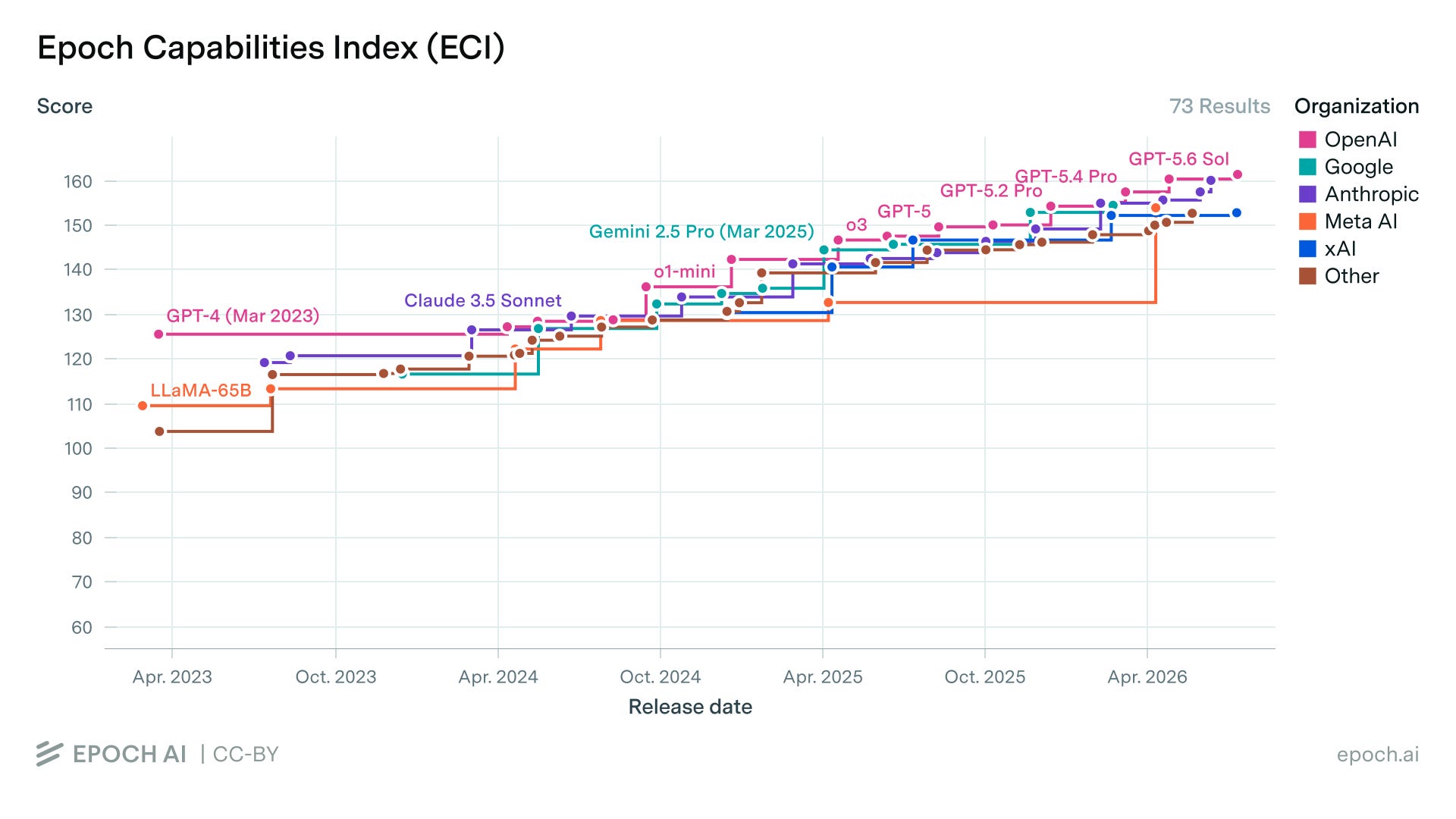
This matters for everything that follows: the idea that the frontier’s lead is real and lasting does not describe the market’s current dynamic. That is why the scenario needs self-accelerating capability jumps, recursive self-improvement, and a hard AI takeoff. Which is worth pausing on: the premise is not an extrapolation of the observed trend, but a bet that the trend breaks.
The scenario also forecloses the possibility that the valuable frontier turns out narrow, specialized, or architecturally different. These are open questions among the people who build these systems. The scenario resolves them by assumption.
A caveat applies to this entire discussion: the frontier’s lead is a lead on benchmarks, and benchmarks are the industry’s own scoreboard. Labs train their models with the scoreboard in view, and the link between benchmark points and economically useful capability is asserted far more often than it is demonstrated.
Premise 3: the frontier is valuable to its owners
The next two bets are economic rather than technical. The first is that the labs that hold the frontier capture enormous value, and, by virtue of building the best model, enrich the country that hosts them.
This is not how the AI economy has looked so far. The labs themselves have collectively lost tens of billions building frontier models. Recent profitability milestones at individual labs like Anthropic do not settle the bigger question of what the market will look like in the long-run.
There is also a name for the possibility that the premise simply fails: the commodification thesis. Once models are interchangeable, they become commodities and are sold on price rather than distinctiveness. There are two different paths to this outcome: several labs could offer closely matched proprietary models, which would let buyers switch on price. Or open-weight alternatives could catch up and become good enough. On either path, the differentiation of frontier models would be fleeting, and most of the value could flow elsewhere: to compute suppliers and to the firms deploying models downstream. This may or may not happen. But the scenario never contemplates that it might.
The scenario’s recommendations are also suspiciously silent on the conditions under which massive profits for AI labs would benefit the economies where these companies are headquartered: profits enrich shareholders or investors, not automatically countries, and turning one into the other requires taxation and massive redistribution. The fictional scenario contemplates these, but the authors’ recommendations mention neither. What they do propose is weakening labour protections and deregulation, which is to say, the transfer runs the other way: the public makes concessions to the companies, not the companies to the public.
Premise 4: the frontier is valuable to the national economy of its users
The second economic bet is the one the entire scenario rests on, namely that economies deploying frontier models capture value through access, so an economy cut off from the frontier is cut off from the value (the scenario renders this in devastating terms, with economies relying on models behind the frontier left ruined).
This premise is the core reason why the scenario argues that Europe should abandon all ambition to build its own frontier model. This is seen as both futile and, implicitly, unnecessary. But even here, two open questions are treated as closed.
First, what Europe keeps is not the value frontier AI potentially generates, but what is left after the companies that control the models and the infrastructure have taken their share. And those companies set their own terms and prices. A better model is only worth running if the extra capability justifies the higher cost. Will it?
This is the key question: will running US models on US infrastructure generate more for Europe than it extracts from it? The scenario assumes the answer is yes, but it never argues for it.
Second, deployment only requires the frontier if the frontier premium is decisive. It is not enough for the frontier to be better: the additional cost of deploying the largest models needs to be justified by their added value. If good-enough models are also significantly cheaper to run, their deployment may make economic sense for many tasks and use cases.
Premise 5: Europe can play a key role in the upcoming physical AI revolution
The final bet concerns Europe itself. While the scenario holds that Europe can no longer meaningfully compete in LLMs, it assumes the continent can play a key role in the coming wave of robotics and industrial AI. What the scenario fails to explain is that this is precisely an area where US hyperscalers are already competing (Amazon has an industrial robotics fleet of over 1 million, is a leading robotics developer, and (through AWS) the infrastructure provider that also invests in robotics startups, granting AWS cloud credits to ensure their business runs on Amazon’s cloud).
I’m not saying Europe shouldn’t invest in these domains. But in Europe 2031’s best case scenario, where it has become even more dependent on three hyperscalers, European industrial AI would end up running on infrastructure owned by the firms it is meant to be outcompeting. Perhaps that is why the authors recommend that Europe also form partnerships with American companies in this domain. What those partnerships would look like, and whether they too would be coercible, remains unsaid.
Part III: The scenario’s unconvincing security guarantees
All of these premises need to hold. And all of the many concessions are only worth it if the deeply entrenched dependence on both hyperscaler infrastructure and proprietary frontier models cannot simply be switched off, or otherwise used in ways that create harm to people in Europe, its economy, or society.
The scenario grants that Europe’s AI compute and frontier-model dependence can be weaponized, then proposes that ‘security guarantees’ negotiated with Washington via a coalition of ‘middle powers’ will secure it. But as Part I showed, these ‘middle powers’ are also implicitly cast as Europe’s competitors for the same finite chips, capital and energy. The coalition is meant to pool bargaining power among countries the build-out sets against each other.
If the idea that regional investments alone are enough leverage to secure access to a technology strikes you as highly unlikely, bear in mind that it is something the scenario itself refutes. At the turning point, the moment Europe tips from difficulty into crisis, the United States switches off access to compute: the 2029 inference-rationing rule that drops Europe into Tier 2 and halves its compute allocation. Tellingly, this is not framed as a betrayal but as a routine executive decision made under scarcity, which is precisely why no legal guarantee can prevent it. A guarantee that holds only as long as it costs Washington nothing is not a guarantee at all.
The scenario is also silent on the many other ways in which Europe would be dependent. Assume the scenario’s premises all come true: Europe would find itself running its economy on models that are developed and controlled elsewhere. Their pricing, their terms of service, their safety, and the ability to audit them independently would all be decisions made elsewhere or subject to negotiation. Access alone does not mean the ability to shape how AI can and cannot be used. If disinformation, hate speech, or political ads on social media concern you today, a world in which the entire economy runs on a single proprietary US model, or a small set of them, should terrify you. And mind you, this is not Europe 2031’s dystopian warning. It is the outcome if all of its recommendations were implemented and worked as intended.
Part IV: Alternative AI futures the scenario never entertains
What should have become clear by now is that Europe 2031 rests on a number of assumptions that aren’t just technical: the geopolitics, and economics all need to add up for the projection to make sense (and for its radical recommendations to add up).
In reality, there are many possible trajectories the AI market could take:
Possibility 1: The AI market corrects sharply
Let’s start with the trajectory Europe 2031 dismisses as the chorus of voices who underestimate AI’s capabilities: the AI bubble bursts. A significant market correction is a real possibility, and not only if AI fails to deliver on its promises. It could also come from the mismatch between long-term AI assets and the short-term debt financing behind them.
Simply put, the vast ecosystem of chipmakers and infrastructure partners will need to see returns on the estimated 4 to 8 trillion USD projected to flow into AI infrastructure by 2031.
Everyone, from Goldman Sachs (saying the business case remains unproven) to the Bank of England, the Bank for International Settlements (known as the central bank for central banks), and the European Central Bank has warned about the risk of a market correction.
One assumption I have heard in several of these meetings is that an AI bubble burst would actually be beneficial for Europe, because it would create space for alternatives to emerge. That ignores that big market moves can have serious negative and destabilizing impacts on the economy, not to speak of people’s pensions and livelihoods. Investors can buy the dip; central banks are responsible for the health of the whole economy. They do not raise risks of this kind lightly.
It also ignores that a bubble burst alone won’t make market concentration magically disappear. If anyone is set to survive a serious market correction, it is large US tech companies (not European challenger AI start-ups). The ECB in particular warned that concentration among a handful of large US-based tech firms leaves global public and increasingly private markets exposed to shocks to these firms. Worse, as AI Now’s Amba Kak and Sarah Meyers West have already argued last year in the Wall Street Journal, the public may already be left to hold the bag as AI companies are deemed too big to fail.
If anything, the real possibility of a market correction deserves much more political attention in Europe, including scenario planning on how to respond.
Possibility 2: AI models could commoditize
The second trajectory is the one I already mentioned under Premise 3: a future in which the most advanced AI models become interchangeable and commoditize. Ben Thompson, a leading industry analyst, is one of the many people who have made this case. His version of this argument rests on open-weight models catching up and becoming good enough for most purposes; a possibility the Europe 2031 scenario foreclosed with a global ban (more on this below). When a product becomes a commodity, its price falls toward what it costs to produce, and for AI models that cost is computing power. Value flows to whoever controls the scarce inputs (Nvidia, TSMC, the memory makers, and upstream ASML), and to whoever can run models most cheaply at massive scale (the hyperscalers). In this logic, the frontier becomes a loss-maker, while money is being made at the infrastructure level.
There is a second branch to this argument. In a new essay, Arvind Narayanan and Akash Kapur (whose “AI as a normal technology” thesis I mentioned above) argue that the AI companies see the commodity trap coming and are moving up the stack, into enterprise products and AI “digital workers” embedded so deeply in an organization’s workflows that removing them becomes prohibitively expensive. On this branch, the models commodify but dominant AI labs (and hyperscalers) profit anyway, by locking-in their customers (businesses and the public sector), who are finding it difficult to leave.
Both versions of this trajectory undermine the scenario’s recommendations. If the companies fail to escape the trap, frontier-level capability becomes cheap and abundant, and access to it, the thing the scenario proposes Europe pay so dearly for, needs no securing at all. If the labs succeed, they do so by locking in their users, and the scenario’s recommendations would make Europe that locked-in user at a continental scale. Either way, durable value sits in infrastructure, distribution and the enterprise layer. Europe would surrender what becomes valuable. In one case it buys what becomes cheap; in the other, what it can no longer leave.
Possibility 3: Open-weight models stay good enough
A third possibility (partially included in the commodification thesis) is that open-weight models remain good enough, and the route to them stays open. The scenario forecloses this trajectory twice: it assumes Europe’s own models are too far behind to matter and both Washington and Beijing ban open models. It has to: open weights run through both versions of the commodification trajectory.
Part of this assumption is fair. Trying to beat the leading labs at the frontier within an LLM-like paradigm is incredibly challenging: hyperscalers and leading labs control the inputs (talent, capital, compute, data) and the distribution channels; competing means entering a race whose odds are structurally stacked against you. That is also a common critique of the EU’s gigafactories approach, which has fixated narrowly on compute for frontier model training with grossly inadequate resources needed to actually compete.
But accepting that Europe cannot win the frontier race is not the same as accepting everything Europe 2031 asks Europe to give up. In every trajectory where the frontier’s lead is not decisive, durable and valuable all at once, even models behind the frontier are worth having, and Europe could own them. Nor does that require spending billions to replicate what OpenAI or Anthropic have built. Europe could train smaller models from scratch. It could take open-weight models that are already close to the frontier and adapt them for its own purposes, gaining control over the result, and skills and expertise along the way. Or it could do both as a hedge. The point is not that I am recommending any one of these paths. It is that paths exist, and the scenario’s politics of inevitability depends on the reader not seeing them.
Which brings us to the scenario’s ban. In Europe 2031, both Washington and Beijing outlaw open-weight models, and with them the paths just described. The scenario needs this plot device, because otherwise the story would end differently. Today, open-weight models are the route to good-enough alternatives to proprietary US models: their weights can be downloaded by anyone, free, and run on hardware of one’s choosing. GLM 5.2, built by the Chinese company Z.ai, matches or comes within a few points of the current offerings from OpenAI and Anthropic on many benchmarks. Such open models could be banned. But they could also continue to exist.
Open-weight models are central to China’s global diffusion strategy; banning them would mean Beijing disarming its most effective competitive instrument. Even if a ban arrived, weights already published cannot be recalled. These only become irrelevant if the frontier keeps racing ahead (and remains or becomes the place where economic value gets generated).
No matter the trajectory, Europe needs to shape this market
What all of these trajectories have in common is that none of them suddenly makes Europe less dependent. The AI market is structurally concentrated in ways that are hard to undo, whichever future arrives. European AI policy has seriously wrestled with neither the scope of Europe’s dependency nor the technical and economic uncertainty of AI’s trajectory.
But concentration and uncertainty doesn’t mean the market cannot also be shaped.
As Leevi Saari has long argued (and which we will also explain in an upcoming piece with Tech Policy Press), the hyperscalers function almost like private industrial policy, supporting their ecosystems with subsidized computing power, financial guarantees and expanding private coalitions. The question, then, is not whether the market gets shaped, but by whom. The trajectory is uncertain precisely because it is still being decided; which of these futures materializes depends in part on choices that have not yet been made. Europe should be one of the actors making them.
Whether models commoditize depends partly on whether large buyers demand portability or accept lock-in (and whether regulation and enforcement enables switching). Whether open-weight models stay relevant depends partly on whether anyone with resources keeps building on them, and on whether public procurement helps to create demand for them. Whether the labs’ migration up the stack ends in entrenchment depends on whether interoperability requirements arrive before the moats harden or after. Whether the orchestration layer, the software that increasingly decides which model gets called at all, becomes a new chokepoint depends on whether enterprises adopt the bundled stacks of hyperscalers and AI labs or insist on independent, multi-model tools (and on whether competition authorities treat that bundling as tying). And whether anything beyond the LLM paradigm ever matures into an alternative depends on who funds the long-horizon research the scaling race crowds out.
Or take inference compute. European cloud providers face a chicken-and-egg problem: without demand for running even the largest open-weight models, they cannot justify investing in AI-grade infrastructure, and without the infrastructure, the demand goes to the hyperscalers (see our other Tech Policy Press piece on this). This is another example of how vital public procurement is to creating European alternatives in a captured market. This is not about forcing companies and the public sector to use sub-par technology; it is a necessary lever, among many others, for creating the conditions that reduce Europe’s dependence in the long term.
Europe obviously cannot dictate the AI market’s direction. But it is not a bystander to it either.
Part V: AI as a permanent state of exception
Which brings me back to Europe 2031 and why it is not just any bet, but a politically risky one. None of the core premises the scenario builds on are settled. And yet the scenario asks for radical, norm-suspending action as though they were, which is where its politics begin to trouble me. It only works if you hold very specific beliefs about AI’s trajectory. And even if you do, there is more than one way to respond.
There is a fine line between taking a real challenge seriously and suspending all ordinary politics. Most readers, far less familiar with the degree of uncertainty behind the scenario’s premises, will be left with fear.
The prescriptions (wartime-scale state capital, special economic zones, streamlined permitting, investment screening) concentrate executive power and would arguably require bypassing democratic processes. The scenario does wrestle with this, as the Commission protagonist agonizes over what could have been done.
But the scenario’s rhetoric is still designed to inspire drastic measures, including loosening labour laws and other hard-won protections, and feeds a broader narrative in which AI’s inevitable progression justifies suspending all ordinary rules: a permanent state of exception. All of this risks manufacturing the legitimacy crisis it gestures at elsewhere, never quite saying the quiet part out loud. In the world this scenario outlines, Europe has to choose between democracy (slow, inefficient) with economic collapse, and a politics by decree that benevolently delivers some economic value by granting Europe frontier model access. Who exactly benefits from this, how the wealth is distributed, and how any of this squares with the enormous environmental cost of a massive compute build-out, are questions the scenario never answers.
For policymakers in a democracy, the will of the people is more than a comms project. Public scepticism is not a misjudgement to be managed; ignoring it risks further undermining the legitimacy of the democratic project itself. I am genuinely concerned that billions spent on an AI bet that doesn’t deliver could further deepen distrust in the very political institutions we need the most right now.
Evidence-based policy making simply cannot make decisions of this magnitude on a single scenario. I have recently heard policymakers draw parallels to Covid-19 (and the scenario reaches for exactly this analogy in its closing pages). The idea being that decisive and unprecedented action was also needed during Covid, based on partial information - even if the public wasn’t always fully on board. But AI is categorically different. We are not talking about virology and public health; we are talking about hypotheses about AI’s trajectory and assumptions about how these interact with economics and geopolitics. This is deeply political, and treating assumptions as facts depoliticizes what should really be a debate.
Part VI: Radicalism, aimed in the wrong direction
Seen this way, the deepest flaw in Europe 2031 is not any single premise but that it treats the market’s evolution as a force of nature to which Europe can only submit on the best available terms. It then demands extraordinary measures as the price of submission; measures Europe would not contemplate in ordinary times, which is why the future needs to be presented as if it’s already decided. All while treating a deeply sceptical public as something that just needs more positive narratives about AI.
My objection is not to the scale of the scenario’s ambition. Europe should be capable of radical action and years of caution have clearly not worked. The objection is to its direction: the scenario finds the language of emergency for buying American chips and partnering with American hyperscalers, but treats seriously reducing hyperscaler dependence as either impossible, or too disruptive to attempt. Yet nothing makes radicalism in the other direction less available: the scenario’s own wartime register, pointed at Europe’s dependence rather than deeper into it, is a perfectly coherent programme, just not one its authors chose to write.
And since we are already contemplating the unprecedented, why not spend that political capital on the genuinely unprecedented thing: an economy everyday people actually benefit from, rather than one where wealth concentrates in the hands of a very few? The real choice in front of Europe is not between the scenario’s bet and doing nothing. It is between radicalism that deepens dependence and radicalism that creates a future people are genuinely excited about, not one they are driven towards out of fear.
Thanks to the many many smart people who have provided valuable feedback and criticism on various versions of this text: Felix Sieker, Soizic Pénicaud, Max von Thun (do read this excellent critique of Europe 2031), Zuzanna Warso, Alek Tarkowski, Maximilian Gahnz, Johanna Prüssing, Donncha, Julia Heckman, and many conversations with Leevi Saari. All mistakes are mine.
And thanks to this year’s AI Renaissance for giving me the space to think, and debate.